Saturday, August 9, 2014

DID ALL THAT REALLY HAPPEN #2: Teaching Can Be – Exciting!

Obstacles discourage even the best teachers in every geographic and social environment.  Good teaching is not easy – and good teaching is not recognized monetarily across continents.  Businessmen can make millions, but the teachers who developed their creative minds and critical thinking will never have real discretionary income. 
 
Now consider Tanzania.  On top of low salary prospects, most Tanzanian teachers face classes of 40 to 80 in size (this is primary and secondary school – not University 100-level classes), few books, no Internet connection, no budget to fix a classroom and no supplies as basic as pens and paper.  Further, many parents and guardians simply still do not value formal education.  Girls are steered toward marriage. Boys, too often, are not steered toward anything.

It’s easy to preach about group work, effective discipline and active learning.  It’s much more difficult to apply these methods in a developing society’s school system.  Nevertheless, July’s Teacher’s Workshop tackled these issues. U.S. and Tanzanian educators discussed the HOW:  how to prepare a good lesson plan, how to ask higher level questions, how to use partnering and group work even in a large classroom, and how to approach discipline in a society that still uses corporal punishment.

MOST EXCITING! In special sessions, sponsored and Kilimahewa teens joined the teachers in a kind of laboratory for teaching math and science. U.S. teachers, fresh off their week of camp math, demonstrated – and let students demonstrate – how to attack basic math concepts in groups and at the board. The day was truly remarkable as students, often discouraged from trial and error and often not permitted to come to the blackboard, engaged with teachers in ways uncommon for Tanzania.  Local teachers then joined the collaboration, guiding the students in groups as the teens worked on questions they had brought for review.


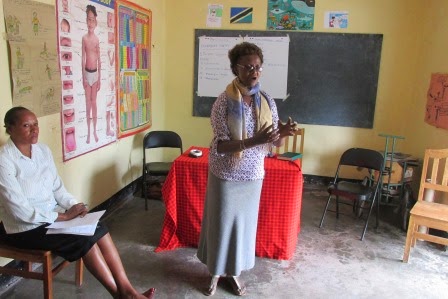
Colleen, a U.S. science teacher, explains how to devise and use simple ways to demonstrate concepts.


First, Andy, one of our visiting U.S. Math teachers works through a problem.... Now it's Mary's turn... and it's ok to make mistakes, and keep going.                      
True collaboration! Tanzanian and U.S. educators and their students.

Productive - squaretable - discussions!

These pictures demonstrate how one day can be a positive force for all involved in order to  help teenagers struggling to learn in a rigid system.

DID ALL THAT REALLY HAPPEN?

When in the throes of an event, it's tough to break away to report or reflect on what’s happening.  So it was with EdPowerment’s Summer Intensive: three weeks comprised of an Enrichment Camp, Sponsored Student meetings and tutoring, Teacher’s Workshops, ACT (Autism Connects Tanzania)’s Professional Two-Day Workshop and of course, the unscripted.

Now, a month later, here is the first in a series of blogs to share the substance and impact of EdPowerment’s community outreach this Summer. 

Learning Can Be – Exciting!


Math and science.  These are the bane of many students’ existence.  They are two of the words in what is arguably the most discussed acronym in education today – STEM.   And… when taught with clarity and enthusiasm, they can both excite and fuel student learning.

Math and science were two subjects targeted in EdPowerment's Kilimahewa Enrichment Camp and subsequent Teacher’s Workshop.  In its second year, EdPowerment’s Enrichment Camp used the semester break in the Tanzanian academic calendar to bring together local teens (over 100 secondary and high school students) and U.S. volunteers, most of whom were professional educators this year.  The goal?  To light the spark of curiosity.  To turn a school break that would otherwise be wasted into a celebration of learning.  

This year’s surprise was that out of 6 subjects (math, science, art, computers, physical education and health, and English) taught at Camp, the oft-dreaded science and math captured the most student attention.  U.S. teachers came to TZ prepared to bring these subjects alive.  Their planning, flexibility, and simple teaching tools – supported by  a talented group of sponsored students who served as translators/ assistants – turned math and science periods into real learning labs.  

Teens hovered around experiments, worked in groups to come up with answers and solutions, and grasped previously learned concepts in a new way.


Density, temperature measurement and expansion, geometric measurement, algebraic equations – these were some of the topics.  Physics bouncing balls, jelly marbles (absorbent polymers), math boards, string and tape – these were some of the tools that helped conceptualization.

And not to be ignored, even English came to life as students competed in antonym BINGO for coveted prizes.

“AHA moments” abounded in this year’s Enrichment Camp.


Next up:  Teaching Can Be – Exciting!

Friday, March 28, 2014

Where Autism Speaks in a Whisper


This month EdPowerment’s outreach for the autistic and otherwise intellectually disabled, (ACT/Autism Connects Tanzania) began a new chapter:  support visits to rural villages.

The stigma that plagues the disabled in Tanzania is fiercest in areas untouched by modern science or medicine.  The disabled remain hidden.  They are a social embarrassment or worse.  Any attempt to educate or nurture them is widely considered useless.  To support those who, desperate for knowledge, have travelled from rural villages to ACT’s Workshops in Moshi, we have begun follow-up visits to their own villages.

By meeting guardians and educators in their own environments, Field Coordinator, Grace Lyimo, and special needs professionals can give practical guidance for home and classroom care.  Just as important, we can help local villagers impacted by disabilities to build homegrown support groups.  Last November’s Workshop, held at the Gabriella Children’s Rehabilitation Centre, focused on the need for this kind of network– a concept common in the U.S. but unknown in this part of the world.  In fact, rural villages are where support groups can make the most difference, given the virtual lack of services by any other provider.


Here are some pictures from ACT’s visit on March 14 to Mto wa Mbu in the Ngorongoro District, Manyara region where we coordinated with an NGO special needs school- Pambazuka.  Those who were willing to brave the stigma of disabilities and attend the meeting formed 5 small community groups where they will:


    Ø  Share experiences, ideas and information.
Ø  Learn ways to address their children’s physical and mental challenges and help them become more independent.
Ø  Advocate for special services, health insurance and other government and community support.
Ø  Educate the community about special needs children/young adults and the importance of protecting and including them in schools. 
Ø  Initiate small income-producing projects that can sustain themselves.
Ø  Invite officials, NGO leaders and others to offer seminars on topics that will help them to advance.
Ø  Choose leaders who will act as links to special education centers, the government and other support and community groups.

AUTISM STILL SPEAKS IN A WHISPER IN TANZANIA.  
EDPOWERMENT IS RAISING ITS VOICE.

Thursday, February 6, 2014

THE PAYOFF

Hongera – Congratulations!

Last week, the National Exams Council of Tanzania (NECTA) announced the results of the 2013 Form 2 National Exams… and our sponsored students rocked it!

Our seven students, now in Form 3, all celebrated excellent scores- 6 scored a B and one even scored an A.  Why is this so remarkable and why does it matter?

A little background:

In Tanzania, national exams play a deciding role in every student’s future. 
  • The Primary School “Leaving” Exam (PSLE) administered at the end of Standard (Grade) 7 determines whether one can continue to government secondary school. Roughly only half of primary school students “pass” this exam. 
  • After primary school, secondary school or “O” for Ordinary School consists of Forms 1 through 4.  Students take national exams at the end of Form 2 – if they fail once, they repeat the grade and “resit.”  If they fail again, they’re out. This year, only 47% of exam takers passed with a D or above.


  • The National Exam at the end of Form 4 is even more critical.  Depending on one’s score, a student can continue to “A” Level High School (Forms 5 and 6), vocational school, a Certificate program in eligible subjects OR – again, he or she is done.  In 2012, 65% of the Tanzanian Form 4 students FAILED the exam and so ended their educational and career prospects.
  •  Finally, there is a Form 6 National Exam and these scores determine whether and where one can continue to University studies.
The tragedy is that, in fact, most Tanzanian government schools (particularly those that serve agricultural villages) lack even the most basic of resources and instruction.  It becomes almost impossible for most students to pass these national exams, much less score a B or an A.

Now you can see why we were so thrilled to get our students’ scores – students without  a good primary school foundation & without family resources and/or support.  Students who overcome unspeakable personal and societal hurdles every day.

If the Form 2 results are any indication, we will be funding a talented bunch of university students in 4 years! This may be challenging financially, but it is also inspiring… and absolutely why we work so closely with our family of students.